Guest Guide
The Island Guide
An island of salt and light off the Vendée coast — where to go, what to eat, and how we like to spend the days.
Noirmoutier lies just off the Vendée coast, about halfway down France's Atlantic side, with the Îles de Ré, Yeu and Oléron for neighbours. It's a low, light-filled island of salt marshes, pine woods, oyster beds and long sandy beaches — popular with the French, but still largely undiscovered by everyone else.
The island has a gentle rhythm. Mornings tend to start at the market, lunch is long, afternoons drift between the beach and the salt marshes, and evenings end with the sun setting straight into the Atlantic. It suits beach lovers, foodies, families, walkers and sailors alike — and anyone who simply wants to slow down. Once you arrive you'll barely touch the car: town is a five-minute walk from the house and the beaches a short cycle away.
A quick sense of the place: a mild, almost Mediterranean microclimate (mimosa flowers here in winter, and the painter Renoir came to capture the light); 83 kilometres of flat cycle paths; some of the best seafood in France; and the famous Passage du Gois, a road across the sea that vanishes under the tide twice a day.
When to come
The classic season is June to September — warm, dry and busy in the best sense, with markets, regattas and beach days. July is the warmest month at around 22°C.
But the island has a quieter charm out of season. Spring and autumn are mild and uncrowded, perfect for cycling and walking. And winter has a particular magic: the beaches are yours, and the mimosa is in bloom, which is why locals call this "the island of mimosas."
Getting here
By car and ferry
Most guests drive. Our favourite route is the overnight Portsmouth–St Malo ferry: sail around 8pm, sleep in a cabin, then roughly three hours' drive in the morning to arrive in time for lunch. Portsmouth–Cherbourg is a shorter crossing with a longer drive (about five hours). As a rough guide, it's 3 hours' drive from St Malo, 5 from Cherbourg, and around 5 from Paris.
By air
Nantes Atlantique airport is about an hour away by car.
By train
Trains run to Nantes or Challans, then it's about an hour by bus or taxi to the island. Paris is roughly 3 hours by train plus an hour on the ground.
Onto the island itself
Two ways across: the bridge ("par le pont"), open at any state of the tide and perfectly straightforward; or the Passage du Gois, the tidal causeway (see its own section below) — only for the right two hours around low tide, but an experience in itself.
Getting around
The island is almost completely flat (its highest point is just 23 metres), the roads are quiet, and there are 83 kilometres of cycle paths — so almost everywhere is reachable by bike. Most days we don't touch the car after arriving. Bikes, e-bikes, children's bikes and rosalies are five minutes away at Le Vél'Hop (take ID and a card). One of the prettiest stretches runs along the Jacobsen jetty out towards the Bois de la Chaize. In summer there's also the free Gratibus shuttle around the island.
There are two main centres. Noirmoutier town, in the middle of the island, grew up around its medieval castle and a long linear port — cafés, shops, restaurants, galleries and delicatessens, with a market in the main square three mornings a week. L'Herbaudière, the working fishing and pleasure harbour at the northern tip (about 15 minutes by car, 30 by bike), has its own cafés looking over the boats, the daily fish market, and the island's three-Michelin-star restaurant.
Food & drink
One of the island's great pleasures. Fresh seafood is the speciality, but Noirmoutier also has three signature products worth seeking out — and a market culture that makes eating in as good as eating out.
The island's specialities
- La Bonnotte potato. A rare, early new potato grown in sea-spray and seaweed-rich soil, hand-harvested in spring. Only about 80 of the island's 12,000 annual tonnes are Bonnottes, which is why they're prized by chefs across France — delicate, faintly salty, lovely with fish.
- Fleur de sel and sea salt. Harvested by hand from the salt marshes that cover much of the island, using techniques passed down for generations — the island's "white gold."
- Oysters. Grown in the Bay of Bourgneuf and known for their delicate, not-too-meaty flesh. There are tasting huts dotted along the coast, especially around the oyster port of Le Bonhomme and at L'Épine.
Fine dining & special occasions
- La Marine, L'Herbaudière — Alexandre Couillon's three-Michelin-star restaurant, one of the finest in France. Book well ahead.
- L'Ételle at Hôtel Fleur de Sel, and L'Atlantide at Hôtel Punta Lara — refined, sea-view cooking.
- L'Assiette au Jardin, in the old town — more inventive, fusion cooking.
Relaxed & family
- Elise, L'Herbaudière — Couillon's easygoing seafood spot by the fish market, with a fresh-fish counter.
- Le P'tit Noirmout, just behind L'Herbaudière port — small and traditional, the day's catch.
- Le Petit Banc, by the castle — a tiny all-year bistro, great value; book ahead.
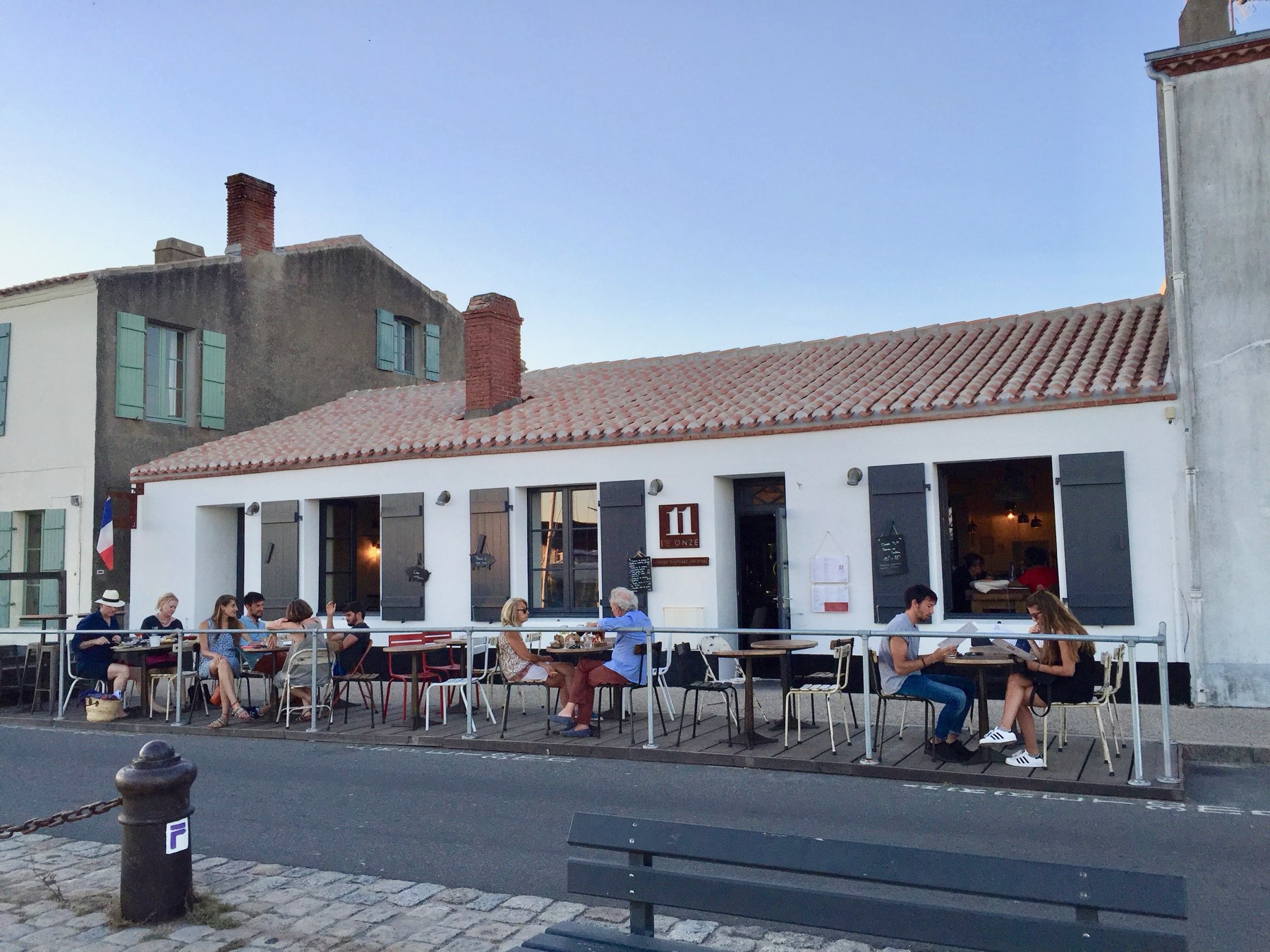
- Le 11, on the old port — oysters, fish & chips and brunch on a portside terrace.
- Le Winch, on the old port — brasserie with burgers, mussels and on-site smoked fish.
- L'Amour à la Plage, Plage des Dames — family-friendly, feet near the sand.
- La Potinière, Plage des Dames — slightly more up-market, also right by the beach.
Drinks & evenings
Nightlife here can be as simple as a ride to the beach with a bottle of rosé and a rug as the sun sets into the Atlantic. In town, Café Noir on the port has been the island institution since 1975 — lively in the evening, with occasional live music. Le Bikini, near Plage des Dames, is the spot for a cocktail on the way back from the beach. For dancing, Cabana Coco at L'Épine runs late into the night in summer.
Eating in
The market is a destination in itself — Friday all year round, plus Tuesday and Sunday mornings in season (roughly April to September), with an extra market at L'Herbaudière on summer Mondays. Expect seafood straight off the boats, charcuterie, cheese and produce. Pick up bread at La Mie Câline, charcuterie at Maison Chevallereau, fish at Les Tadornes, and wine at Cave La Réserve.
Beaches
A different beach for every day and every mood. Some have a café or restaurant alongside, some are set up for watersports, others are all but deserted at any time of year. Thanks to the island's position in the Gulf Stream, the Atlantic-facing west coast can be surprisingly warm — sometimes warmer than the sheltered east.
- Plage des Dames — the postcard beach: sheltered and pretty, backed by the Bois de la Chaize and its white bathing huts, with its old wooden jetty. About 10 minutes by bike; pay-and-display near the beach or free in the side roads; cafés and a sailing school close by.
- Plage des Sableaux — a favourite for families: supervised in summer, with a children's beach club in July and August.
- Luzeronde — rugged Atlantic surf on the west coast, near L'Herbaudière (down the Rue du Luzeronde to a small car park, then a short walk).
- The west-coast beaches — Plage de l'Océan, Plage du Midi and Plage des Boucholeurs together give around 7km of sand, and are the place for sailing, windsurfing, kitesurfing and land yachting.
- L'Épine, L'Anse Rouge and La Madeleine — long pine-backed stretches and quieter coves.
- Also worth a ride: La Claire (near Le Vieil), Le Vieil, Les Souzeaux, and further south Barbâtre and La Guérinière.
For children, the rocks between La Madeleine and Le Vieil have tide pools full of winkles and shore crabs at low tide.
Things to do
On and by the water
- Sailing, windsurfing, paddleboarding, kayaking and catamarans — schools and hire, including at Plages des Dames.
- Sand yachting (char à voile) on the wide Barbâtre beaches at low tide; kitesurfing on the west coast.
- Motor-boat hire, and boat trips across to the Île d'Yeu.
- Coastal and offshore fishing; rock-pooling; and pier-jumping with the locals (up to 4m at low tide, for the brave only).
On foot and by bike
- The Bois de la Chaize, above Plage des Dames: 110 hectares of maritime pine, evergreen oak, strawberry trees and mimosa, lining more than 2km of beach and broken by rocky headlands and sandy coves. A listed site since 1936, and a favourite of Renoir's. In winter the mimosa turns it gold.
- The salt marshes draw migrating birds — avocets, shelducks, terns and black-winged stilts — and make wonderful flat, quiet cycling.
- Running and walking tracks along the coast and inland; tennis; and of course the cycle network.
Salt & oysters — a taste of the island
Between June and September, salt-makers open their marshes to visitors, walking you through the maze of clay pools and astonishing colours and explaining a craft that's barely changed in a thousand years. Oyster growers along the coast (around Le Bonhomme and L'Épine) run educational visits that end, naturally, with a tasting. Both make a lovely half-day with children or friends.
Heritage & culture
- The Château de Noirmoutier — one of the best-preserved castles in western France, its keep dating from the 12th century (the island's defences go back to 830 and the Viking raids). It served as a military prison during the Revolution; General d'Elbée was executed in front of it in 1794, a key moment in the Vendée wars. The keep now houses the island museum (local history, marine collections and over 600 pieces of Jersey earthenware), with a new exhibition each year and a fine view from the top. The courtyard is free, and Saint-Philbert church stands just beside it, forming the historic heart of the island.
- Galleries dot the town, and the Atlantic Wall blockhaus museum (Blockhaus R627, La Guérinière) tells the WWII story among the still-standing gun emplacements on the west coast.
Events & festivals
Summer brings a steady programme: concerts in the castle, art exhibitions, outdoor cinema, night markets and guinguette evenings. The sailing calendar is a highlight — the Régates du Bois de la Chaize in August (around 70 boats, with traditional boat parades you can watch from the beach and the jetty) and the Noirmoutier Classic in early August (60-plus classic yachts and keelboats racing in the Bay of Bourgneuf).
For children
There's no shortage to keep children busy: sailing lessons and beach clubs; the Île aux Papillons butterfly house and Mini-Ville miniature village; the little tourist train (Noirmout'Train) and Hippobus horse-drawn cart tours; horse riding, mini-golf, quad bikes and the laser game; the cinema, the playground and skate park; cockle-hunting and a walk out along the Gois at low tide.
A few of our favourite days
Here's how the days tend to fall for us — an easy morning, a long lunch, and an afternoon at the beach or out on the bikes. Mix and match.
Easy mornings
- Into town. Five minutes on foot: croissants from La Mie Câline, a coffee by the port, and a browse round the shops and galleries before the day warms up.
- A run along the jetty. Out along the Allée Jacobsen to Plage des Dames and back — flat, scenic and quiet first thing, with the Bois de la Chaize on one side and the bay on the other.
- Market morning. Friday all year, plus Tuesday and Sunday in season (and L'Herbaudière on summer Mondays). Go early, pick up seafood, charcuterie and bread, and you've got lunch sorted.
- Tennis or padel. A game first thing before the heat, then off to the beach.
Five afternoons
- Plage des Dames day. Ten minutes by bike to the island's prettiest beach — sheltered swimming, the white bathing huts and the old wooden jetty. Spend the afternoon between the sand and the shady coastal paths of the Bois de la Chaize, with lunch or an ice cream at L'Amour à la Plage (or La Potinière for something a little smarter), and a cocktail at Le Bikini on the way home.
- L'Herbaudière lunch and Luzeronde. Cycle up across the salt marshes to the fishing port of L'Herbaudière (about 30 minutes, flat all the way, with avocets and shelducks for company). Lunch by the boats — Elise or Le P'tit Noirmout, or La Marine if it's a special occasion. Then on to nearby Luzeronde for a rugged Atlantic afternoon, ending with the sun going down over the sea.
- Le Vieil and La Claire day. A gentler one for families. A short ride to the quiet east-coast beaches around Le Vieil and La Claire — calm, shallow water for swimming, and tide pools between La Madeleine and Le Vieil where children can hunt for winkles and shore crabs. Take a picnic from the market.
- The north-east loop to L'Herbaudière. A proper bike day. Follow the Allée Jacobsen and the wooded paths along the north-east coast up to L'Herbaudière, watch the boats come and go over a drink, then loop back across the salt marshes. Mostly traffic-free, beautiful, and easy underfoot.
- South to Barbâtre and La Guérinière. Pick up the dedicated north–south cycle path and head down the island to the big open beaches at Barbâtre and La Guérinière — the spot for sand yachting, windsurfing and space to roam. Look in at the Atlantic Wall blockhaus museum at La Guérinière, and you're near the Passage du Gois at the southern tip if the tide is right.
The Passage du Gois
The island's signature sight, and worth planning around. The Gois is a 3km cobbled causeway across the bay that is completely covered by 1.3 to 4 metres of water for most of the day, surfacing only for an hour or two either side of low tide. It formed naturally over a thousand years as currents in the Bay of Bourgneuf laid down a ridge of silt; the first written mention dates to the 9th century, and it was paved in the late 1930s.
It's an extraordinary thing to drive or walk — but the tide comes in fast, and visitors are caught out every year, which is why rescue poles stand along its length for anyone who misjudges it. Always check the tide times and don't push your luck. At low spring tides the exposed mudflats fill with locals digging for cockles, clams and oysters.
The causeway has its own folklore: the Foulées du Gois, run since 1987, is a 4km foot race against the incoming tide (the fastest finish with dry feet; the rest wade or swim), and the Tour de France has crossed it twice, in 1999 and 2011 — the 1999 stage famously undone by a crash on the slippery surface.
Days off the island
There's more than enough to fill a holiday without leaving, but if you fancy a day out:
- Île d'Yeu — a lovely neighbouring island, reached by ferry from nearby Fromentine (about 30–45 minutes) or from Barbâtre on the island's south. Hire bikes on arrival and make a day of it.
- Nantes — a handsome, arty city with a playful side (the giant mechanical elephant on the Île de Nantes is a hit with children).
- Marais Poitevin — the "Venise Verte," a green maze of waterways you explore by flat-bottomed boat.
- Puy du Fou — one of the world's great theme parks, built around spectacular historical shows rather than rides, with a famous evening "son et lumière."
- Planète Sauvage — a drive-through safari park.
- Further afield, easy to fold into a longer tour: Bordeaux, the Loire châteaux and vineyards, or the Brittany coast.
Useful to know
- Tap water is safe to drink.
- No WiFi at the houses, but mobile phone signal is good — a roaming or data package covers most needs.
- House rules: no pets, no BBQs in the compound (use the beach picnic areas), quiet outside after 10pm.
- Tourist office: ile-noirmoutier.com — the island's official site, with up-to-date events, opening times and tide tables.
- Anything at all? Nick +44 (0) 7717 551 817, Kirsty +44 (0) 7780 900 432, or lovenoirmoutier@gmail.com.